
Heal Your Love-Hate Relationship with Food
From Guest Contributor, Kimberly Daniels, PsyD
We are grateful to author Kimberly Daniels, PsyD for allowing us to share the introduction to her workbook, “Heal Your Love-Hate Relationship with Food: An Intuitive Eating & Internal Family Systems Workbook ” with you on the Reclaiming Beauty blog. Enjoy her words of wisdom and if you resonate, we highly recommend her workbook.
What You’ve Probably Tried and Why It Didn’t Work
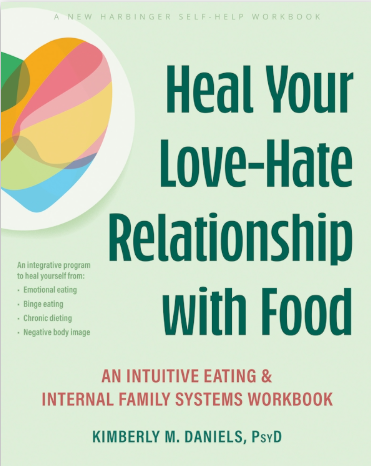
As you read in the introduction, this workbook will teach you how to use IFS and IE to heal your relationships with food and your body. This is the game-changing combination that I’ve seen work countless times with clients. In this chapter, I’m going to tell you a little more about IFS and IE and why using a combination of the two is so incredibly helpful. But before that, let’s quickly talk about what you’ve probably tried in the past and why it didn’t work.
Whether you were attempting to end your emotional eating, stop bingeing, gain control over food, or lose weight (or any combination of these), you likely used restriction to achieve your goals. Restriction feels like control, and control is often the goal (although it really shouldn’t be—control isn’t understanding). This restriction could have come in the form of dieting, medication, or bariatric surgery. All of those approaches are problematic for both physical and emotional reasons.
Physically, your body will rebel against restriction because it doesn’t want to die. And that’s a good thing! If you continue to limit your food intake, your body will kick in and do whatever it can to force you to eat. And it does that in really cool ways, like turning on the hormones that ramp up your hunger level to try to get you to eat; lowering the hormones that tell your body you’re full so you’ll eat more; expanding what your taste buds enjoy in order to get you to eat anything at all. Yes, restriction often leads to eating.
Emotionally, restriction is problematic because food is comforting and enjoyable. We can pass by our favorite foods for only so long before we say, “Enough! I don’t care anymore. I want the damn cookies!” That’s normal. That’s not a lack of willpower or a lack of control. It’s normal to enjoy food and to want to eat foods we like. We cannot sustain depriving ourselves of these foods long-term.
In addition to enjoying food, it is a huge comfort to many of us. My guess is, if I asked you to make a list of your comfort foods, you would immediately start naming items like chocolate chip cookies. Ice cream. A warm mug of hot cocoa. Anything with cheese. Food is comforting, and we all need comfort.
Food is also an amazing distraction. It’s been my experience that one of the main reasons people turn to food is to distract themselves from difficult emotions. And food is really good for that. It’s delicious, enjoyable, and hopefully readily available. And if you’re using food that way, restricting it can become nearly impossible because you suddenly don’t have a distraction. Now that the food is gone, those feelings it was helping you avoid are front and center.
And finally, one of the biggest reasons that dieting, surgery, and medication don’t help your emotional eating is because none of them in any way, shape, or form help you understand why you’re using food the way you are. These methods are all about changing and controlling behavior. They aren’t about understanding it. And behavior change without understanding doesn’t work.
Internal Family Systems and Intuitive Eating: A Game-Changing Combination
I’m going to repeat that point: behavior change by itself, without understanding, doesn’t work. I
cannot say this enough. In order to make a change in your eating patterns, you must understand why you use or restrict food. And there’s no better way to help you understand this than IFS.
Next, we’re going to talk about what IFS and IE are and how the combination of these approaches is different from anything you’ve tried in the past.
What Is Internal Family Sysyems (IFS)?
Quick question: have you ever seen the movie Inside Out? It’s a fantastic Pixar movie where we see five parts who make up the mind of the main character, Riley. This movie is a great example of the core tenet of IFS: our minds are made up of subpersonalities, or parts. Each part has a certain role to play in what we call our internal system, and all of our parts are trying to be helpful to us. Sometimes our parts use or restrict food in order to be helpful. For example, if you are someone who tends to eat in order to zone out when you’re stressed, that means a part of you uses food to help distract you. Or, if you tend to feel the need to fit in well with others, you may have a part who uses dieting to do that.
In addition to parts, IFS holds that we also have a core Self, which is considered to be our authentic self, or our true essence. Our Self is a wonderful resource for our parts and embodies such qualities as compassion, curiosity, calmness, and confidence.
In this book, you’ll be getting to know the parts of you who relate to food in various ways, and you’ll learn how to access your true Self. This understanding will allow you to approach your parts, your body, and food in a much more calm, curious way, which will lead to healing your relationships with food and your body. All of this paves the way to using the skills of IE.
What Is Intuitive Eating (IE)?
Intuitive Eating (IE) is a model created by Evelyn Tribole and Elyse Resch (2020), dietitians who both recognized that the typical way of approaching food and nutrition (that is, counting calories, weighing and measuring food, focusing on weight loss) wasn’t working for their clients. At least not in the long run. So they dove into the research and developed their own model that aims to help you stop dieting, eat foods that you enjoy, no longer fear food, and respect your body.
IE includes ten principles that help you achieve these goals:
1. Reject diet culture
2. Honor your hunger
3. Make peace with food
4. Discover the satisfaction factor
5. Feel your fullness
6. Challenge the food police
7. Cope with your emotions with kindness
8. Respect your body
9. Movement—feel the difference
10. Honor your health—gentle nutrition
The main goal of IE is attunement: the ability to tune into your body and recognize what it needs. When you’re able to do that, you can eat in ways that are satisfying. You will no longer eat to the point of discomfort (at least not regularly), and you’ll eat foods that feel good to your body. You’ll be able to eat your “fear foods” when you like and without having to work them into a calorie count.
How This Approach Is Different
As you read earlier, IFS is the best way I’ve ever found to truly understand why you relate to food the way you do. With IFS, you’ll get to know the specific parts of you who eat for various reasons and those who restrict food. You’ll literally ask the parts themselves why they do what they do. And guess what—they’ll tell you! You don’t have to surmise or guess why they’re doing what they’re doing—you’ll just ask them. And you’ll develop a relationship with those parts that will eventually allow them to shift what they’re doing.
With the help of IFS, you’ll also come to understand that the parts of you who eat when you’re upset, who binge eat, who can’t seem to stop dieting are all trying to be helpful to you. For most people, this is a very different way of looking at their eating patterns. Most of us are extremely hard on ourselves, especially when it comes to our bodies and our eating habits. We tend to be critical and even angry at ourselves. That isn’t at all helpful. You can’t hate yourself into changing.
Instead, with the help of IFS, you’ll be approaching your parts—and your body—with compassion, curiosity, and calmness. With the understanding and self-compassion that IFS provides as your base, you’ll then be able to use the principles of IE to help you stop restricting food and eat the food you enjoy. You’ll be capable of tuning into your body, noticing your hunger and fullness cues, and nourishing it in the ways it wants and needs. Finally, you’ll develop trust in the wisdom of your Self and your body, leading you to approach food with calm awareness and intention.
That may sound like a lot of concepts and lofty ideas, so let’s talk about what will actually change for you. With the help of IFS and IE, you will:
develop a deep understanding of why you use food the way you do;
no longer diet or restrict your food intake;
be able to keep your “fear foods” at home without bingeing on them;
feel at ease with food and no longer need to control it;
treat your body with kindness and respect;
eat in a way that serves your body well;
respond to your body’s hunger and fullness cues; and
regularly enjoy the food you love without feeling guilt or shame.
And you’ll know within your bones that your body is your home, and it’s good enough just the way it is.

ABOUT THE CONTRIBUTOR
.Kimberly M. Daniels, PsyD, is a clinical psychologist who has specialized in treating disordered eating for more than twenty years. She is a certified Level 2 trained Internal Family Systems (IFS) therapist, an approved IFS Consultant, and a Certified Intuitive Eating Counselor. She is passionate about empowering women, and helping them to heal their relationship with food and their bodies once and for all. She lives near Hartford, CT.
Get Started with Internal Family Systems and Intuitive Eating Informed Eating Disorder Recovery Support in Asheville, NC Today
At Reclaiming Beauty, we're here to help you on this journey. Our therapists are all IFS trained and are dedicated to providing a somatically integrated, weight-inclusive and understanding space for you to explore your own trailheads to deeper embodiment. Contact us today to schedule a consultation and take a step towards your healing.
Schedule a consultation with us here so we can get to know your story and your therapeutic interests and match you with the best fit provider at our practice.
Discover more about IFS and embodiment through our IFS blogs and podcasts.
Are you a professional interested in using IFS with your clients with disordered eating? Join our monthly consult group.